Lumen Technologies Porter's Five Forces Analysis

Fully Editable
Tailor To Your Needs In Excel Or Sheets
Professional Design
Trusted, Industry-Standard Templates
Pre-Built
For Quick And Efficient Use
No Expertise Is Needed
Easy To Follow
GET THE FULL COMPANY
ANALYSIS BUNDLE FOR
Lumen Technologies

Don't Miss the Bigger Picture
Lumen Technologies operates in a dynamic telecom landscape where intense rivalry and significant buyer power are key challenges. The threat of substitutes, though present, is somewhat mitigated by the specialized nature of their services.
This brief snapshot only scratches the surface. Unlock the full Porter's Five Forces Analysis to explore Lumen Technologies’s competitive dynamics, market pressures, and strategic advantages in detail.
Suppliers Bargaining Power

Supplier Concentration and Specialization
Lumen Technologies' reliance on a concentrated few suppliers for specialized network components and advanced software solutions grants those suppliers significant leverage. For instance, in 2024, the semiconductor industry, crucial for Lumen's network hardware, experienced ongoing supply chain constraints, particularly for high-performance chips, allowing key manufacturers to dictate terms and pricing.
The uniqueness of certain proprietary technologies or specialized services further amplifies supplier bargaining power. When Lumen requires highly specific, custom-developed software for its advanced managed services or unique network configurations, and only a handful of vendors can provide it, those vendors can command higher prices and more favorable contract conditions, impacting Lumen's operational costs and flexibility.
Switching Costs for Lumen
The bargaining power of suppliers for Lumen Technologies is significantly influenced by switching costs. These costs encompass the financial, operational, and technological expenses Lumen would face if it moved from one supplier to another. For instance, if Lumen's network infrastructure relies on deeply integrated systems or proprietary technologies from a specific supplier, the effort and investment required to transition to a new provider would be substantial, thereby increasing that supplier's leverage.
Importance of Supplier's Input to Lumen's Business
The bargaining power of suppliers for Lumen Technologies is significantly influenced by the criticality of their inputs to Lumen's core operations and service delivery. Suppliers of specialized fiber optic cables and advanced networking equipment, for example, can wield considerable influence if their products are indispensable and lack readily available substitutes.
Lumen's reliance on suppliers like Corning for next-generation fiber-dense cable, as highlighted in their partnership, underscores this dynamic. Such specialized components are vital for Lumen's ability to offer high-speed internet and other communication services, giving these suppliers leverage in negotiations.

Threat of Forward Integration by Suppliers
The threat of suppliers integrating forward into Lumen's business, thereby becoming direct competitors, is a significant factor influencing their bargaining power. If suppliers possess the capability and intent to offer similar services or products, they can leverage this potential to negotiate more favorable terms with Lumen.
However, in the telecommunications infrastructure sector, this threat is generally considered low. The immense capital expenditure required to build and maintain networks, acquire spectrum licenses, and develop advanced technological capabilities acts as a substantial barrier to entry for most suppliers. For instance, the cost of deploying fiber optic networks or 5G infrastructure runs into billions of dollars, making forward integration a financially prohibitive strategy for most.
- Low Forward Integration Threat: High capital intensity in telecommunications infrastructure discourages suppliers from becoming direct competitors.
- Barrier to Entry: The substantial investment needed for network deployment limits the number of potential suppliers capable of forward integration.
- Lumen's Capital Investments: Lumen invested approximately $1.5 billion in capital expenditures in 2023, underscoring the scale of investment required in the industry.
Availability of Substitute Inputs
The availability of substitute inputs significantly impacts Lumen Technologies' bargaining power with its suppliers. If Lumen can easily find alternative materials, components, or services from different providers, or if it has the capability to produce these inputs internally, the power of its existing suppliers diminishes. This is because suppliers face less leverage when their customers have readily accessible alternatives.
For instance, in the telecommunications sector, Lumen relies on various hardware and software components. The presence of multiple vendors offering similar fiber optic cables, network switches, or cloud infrastructure services means Lumen can switch suppliers if pricing or terms become unfavorable. This competition among suppliers inherently lowers their individual bargaining power.
- Broadband Infrastructure Components: Lumen's ability to source fiber optic cables, routers, and other network hardware from numerous global manufacturers, such as Corning or CommScope, limits the power of any single supplier.
- Software and Cloud Services: The increasing availability of open-source software and competitive cloud service providers (like AWS, Azure, or Google Cloud) provides Lumen with viable alternatives to proprietary solutions, thereby reducing supplier leverage.
- Internal Production Capabilities: While not always feasible, Lumen's potential to develop certain in-house capabilities or partner with smaller, specialized firms for niche components can further dilute the bargaining power of larger, established suppliers.
Supplier Leverage: Navigating Telecom's Critical Dependencies
Suppliers of specialized network components and proprietary software hold considerable leverage over Lumen Technologies, particularly when these inputs are critical and lack close substitutes. In 2024, ongoing semiconductor supply chain issues meant that manufacturers of high-performance chips could dictate terms, impacting Lumen's hardware costs.
The high switching costs associated with integrated systems and proprietary technologies further strengthen supplier positions. If Lumen must undertake significant financial and operational investment to transition away from a particular vendor, that supplier's bargaining power increases, as seen with specialized fiber optic cable providers like Corning.
Lumen's ability to source components from multiple vendors, such as various fiber optic cable manufacturers or cloud service providers, helps mitigate supplier power. The availability of open-source software and competitive cloud platforms also provides Lumen with alternatives, reducing the leverage of any single supplier.
| Supplier Characteristic | Impact on Lumen's Bargaining Power | Example/Data Point (2024) |
|---|---|---|
| Supplier Concentration | Increases Supplier Power | Key semiconductor manufacturers could dictate terms due to supply constraints. |
| Uniqueness of Inputs | Increases Supplier Power | Proprietary software for advanced managed services commands higher prices. |
| Switching Costs | Increases Supplier Power | High costs to replace deeply integrated proprietary systems. |
| Availability of Substitutes | Decreases Supplier Power | Multiple vendors for fiber optic cables and cloud services offer alternatives. |
What is included in the product
 Detailed Word Document
This analysis delves into the competitive forces shaping Lumen Technologies' market, examining the intensity of rivalry, the power of buyers and suppliers, the threat of new entrants and substitutes, and how these dynamics impact its strategic positioning and profitability.

 Customizable Excel Spreadsheet
Effortlessly identify and mitigate competitive threats with a dynamic framework that visualizes Lumen's strategic position against rivals.
Customers Bargaining Power

Customer Concentration and Volume
Lumen Technologies' customer base is quite varied, encompassing large enterprises, government entities, and wholesale partners. The sheer size and purchasing volume of these customers directly translate into significant bargaining power.
For instance, major hyperscale clients such as Microsoft, Amazon, Google, and Meta, who have entered into multi-billion dollar agreements with Lumen, can wield considerable influence. These substantial contracts, often running for many years, give these customers leverage to negotiate favorable terms, pricing, and service level agreements, impacting Lumen's profitability and operational flexibility.
Switching Costs for Customers
Switching costs for customers are a significant factor in their bargaining power with Lumen Technologies. These costs can include financial penalties for early termination of contracts, the expense and effort involved in migrating data and services, and the potential for operational disruption during the transition. For instance, businesses relying heavily on Lumen's network infrastructure might face considerable downtime and retraining costs if they were to switch to a competitor.

Availability of Substitute Services
Customers' ability to easily switch to alternative services significantly amplifies their bargaining power. For Lumen Technologies, this means considering other fiber providers, cloud companies increasingly offering integrated connectivity solutions, and even emerging satellite internet services as viable substitutes.
The intensifying competition within the telecommunications sector, coupled with the growing capabilities of cloud providers, directly translates to increased leverage for customers. For instance, in 2024, the global cloud computing market was projected to reach over $600 billion, indicating a substantial shift in IT infrastructure that can impact traditional telecom providers.

Customer's Price Sensitivity
Customer price sensitivity is a major lever in determining their bargaining power against Lumen Technologies. When customers have many choices and can easily switch providers, they become more attuned to price differences. This forces Lumen to remain competitive, potentially impacting its profit margins.
For instance, in the broadband internet market, customers often have multiple providers to choose from, making them highly price-sensitive. If Lumen's pricing is perceived as too high compared to competitors offering similar speeds and services, customers will likely migrate to cheaper alternatives. This was evident in 2024, where reports indicated increased churn rates in the telecommunications sector due to aggressive pricing strategies from rivals.
- High Price Sensitivity: Customers readily switch for lower prices, especially in competitive markets like residential broadband.
- Impact on Lumen: Lumen must align its pricing with market expectations to retain customers and avoid significant revenue loss.
- Competitive Landscape: The availability of numerous alternatives amplifies customer power, compelling Lumen to offer attractive price points.
Threat of Backward Integration by Customers
The threat of backward integration by customers significantly impacts Lumen Technologies' bargaining power. If major clients, particularly large hyperscalers, possess the capacity or a believable threat to develop their own network infrastructure, their leverage to negotiate better terms with Lumen increases. This is because they can potentially bypass Lumen's services altogether.
While not a widespread concern for most businesses, the sheer scale of hyperscalers like Amazon Web Services (AWS), Microsoft Azure, and Google Cloud means they might explore building proprietary network solutions for specific, high-demand use cases. For instance, AWS has been investing heavily in its global network backbone, aiming to reduce reliance on third-party providers for certain connectivity needs. This strategic move by such dominant players directly enhances their bargaining power within the telecommunications sector.
- Customer Integration Capability: Large customers, especially cloud providers, are increasingly building out their own private network infrastructure, reducing dependence on external providers.
- Hyperscaler Investments: Companies like Microsoft Azure reported significant capital expenditures in network infrastructure in 2023, exceeding tens of billions of dollars, indicating a growing capacity for backward integration.
- Reduced Dependence: As customers gain more control over their network components, their willingness and ability to negotiate more aggressively with service providers like Lumen increases.
- Strategic Implications: This threat forces Lumen to offer competitive pricing and superior service to retain these crucial, high-volume clients.
Customer Bargaining Power: A Dominant Force
Lumen's customers, particularly large enterprises and hyperscalers, possess significant bargaining power due to their substantial purchasing volumes and the availability of viable alternatives. This power is amplified by the increasing ease with which these clients can switch providers, driven by falling switching costs and the growing competitive landscape, including cloud providers offering integrated connectivity. For instance, in 2024, the telecommunications sector saw aggressive pricing strategies from rivals, leading to increased customer churn, highlighting the sensitivity of customers to price and service offerings.
| Factor | Impact on Lumen | Supporting Data (2024 Estimates/Trends) |
| Customer Concentration | High dependence on large clients for revenue. | Hyperscalers like Microsoft Azure and Google Cloud represent a significant portion of enterprise IT spending. |
| Switching Costs | Moderate to high for complex deployments, but decreasing with standardized solutions. | Migration costs can involve data transfer, integration, and potential downtime. |
| Availability of Alternatives | Intensified competition from other telcos and cloud-native connectivity. | Global cloud computing market projected over $600 billion in 2024, indicating robust alternative infrastructure. |
| Customer Price Sensitivity | High, especially in commoditized services. | Reports of increased churn in 2024 due to competitive pricing in broadband. |
| Threat of Backward Integration | Significant for hyperscalers capable of building own networks. | Hyperscalers' substantial investments in network infrastructure (e.g., AWS's global backbone expansion). |
What You See Is What You Get
Lumen Technologies Porter's Five Forces Analysis
This preview showcases the comprehensive Porter's Five Forces analysis for Lumen Technologies, detailing the competitive landscape and strategic implications for the telecommunications giant. You're viewing the exact document you'll receive immediately after purchase, offering an in-depth examination of buyer power, supplier power, threat of new entrants, threat of substitutes, and industry rivalry. This professionally formatted analysis is ready for your immediate use, providing actionable insights into Lumen's market position.

Rivalry Among Competitors

Number and Diversity of Competitors
The telecommunications sector is inherently competitive, with Lumen Technologies navigating a landscape populated by numerous players. These rivals range from other major, long-standing telecom providers to newer entrants and even large technology companies, often referred to as hyperscalers, who are increasingly involved in network infrastructure and services.
This broad spectrum of competitors, each with varying scales of operation, distinct strategic aims, and diverse service portfolios, significantly amplifies the intensity of rivalry. For instance, in 2024, major global telecommunications companies continue to invest heavily in 5G and fiber optic expansion, directly competing with Lumen's core business areas.
Industry Growth Rate
The telecommunications industry's overall growth rate significantly impacts competitive rivalry. When the market expands slowly or contracts, companies often engage in more aggressive competition to capture existing market share. This dynamic intensifies pressure on all players.
While specific segments like AI-driven connectivity are experiencing robust growth, the decline in legacy services continues to exert downward pressure on overall revenues. For instance, in 2024, while 5G deployment and related services showed promise, the ongoing shift away from traditional landline services presented revenue challenges for many established providers.

Product and Service Differentiation
Lumen Technologies' ability to differentiate its offerings significantly influences competitive rivalry. By highlighting unique fiber network assets, specialized cloud connectivity, and robust security solutions, Lumen can move beyond pure price competition. For instance, their Network-as-a-Service (NaaS) model aims to provide flexible, on-demand network capabilities, a feature that distinguishes them from providers offering more standardized services.

Exit Barriers
High exit barriers, like Lumen Technologies' extensive fiber optic networks, can trap companies in a market even when profits are scarce. This forces them to compete vigorously, often at lower margins, to recoup their investments. Lumen's significant investment in its roughly 450,000 route miles of fiber network illustrates this point, making it difficult and costly to divest or repurpose these specialized assets.
These substantial fixed assets and specialized infrastructure create a situation where companies like Lumen are compelled to continue operating, even in less profitable segments. This persistence intensifies competition as players are reluctant to exit, leading to prolonged price pressures and a sustained battle for market share.
- High Capital Investment: Lumen's vast fiber network represents a significant sunk cost, making exit prohibitively expensive.
- Specialized Infrastructure: The specialized nature of telecommunications infrastructure limits alternative uses, increasing exit barriers.
- Operational Continuity: Companies may prioritize maintaining operations to avoid significant write-offs on their assets.
- Sustained Competitive Pressure: The inability to easily exit the market ensures that rivalry remains intense, impacting profitability for all players.
Strategic Stakes and Aggressiveness of Competitors
The telecommunications market is intensely competitive, with significant strategic stakes for all players. Competitors are aggressively pursuing market share and investing heavily in next-generation technologies, directly impacting Lumen's competitive landscape.
Companies like AT&T and Verizon are channeling billions into 5G deployment and fiber expansion, aiming to capture a larger share of the enterprise and consumer markets. For instance, AT&T announced plans to invest approximately $24 billion in capital expenditures in 2024, a substantial portion allocated to its network, including 5G and fiber. This aggressive investment strategy forces Lumen to continuously innovate and adapt its offerings to remain competitive.
Furthermore, the emergence of new business models, such as Network-as-a-Service (NaaS), is intensifying rivalry. Competitors are developing flexible, cloud-like solutions that challenge traditional connectivity models. Lumen itself is also pivoting towards NaaS, highlighting the strategic imperative to keep pace with these evolving market demands and technological advancements.
- Market Stakes: Competitors view the telecommunications infrastructure market as critical for future revenue growth, driving aggressive pursuit of market share.
- Technological Race: Significant investments in 5G, AI infrastructure, and Network-as-a-Service (NaaS) by rivals like AT&T and Verizon necessitate continuous innovation from Lumen.
- Competitive Actions: AT&T's planned capital expenditures of around $24 billion in 2024 underscore the high level of investment and competitive pressure in the sector.
- Business Model Evolution: The shift towards NaaS models by competitors creates pressure on Lumen to adapt its own service offerings and strategic direction.
Telecom's Fierce Capital Race
Competitive rivalry within the telecommunications sector is exceptionally fierce, with Lumen Technologies facing intense pressure from a diverse range of players. Major established providers and emerging tech companies are all vying for market share, particularly in high-growth areas like 5G and fiber optics.
Companies like AT&T are making substantial investments, with approximately $24 billion allocated to capital expenditures in 2024, a significant portion directed towards network expansion. This aggressive spending by rivals necessitates continuous innovation and strategic adaptation from Lumen to maintain its competitive edge.
The ongoing shift towards flexible, cloud-like service models, such as Network-as-a-Service (NaaS), further intensifies competition. Lumen's own strategic pivot to NaaS highlights the imperative to keep pace with these evolving demands and technological advancements in a rapidly changing market.
| Competitor | 2024 Capital Expenditure (Approximate) | Key Focus Areas |
|---|---|---|
| AT&T | $24 billion | 5G, Fiber Expansion, Network Modernization |
| Verizon | ~$19-20 billion | 5G Ultra Wideband, Fiber Broadband, Edge Computing |
| T-Mobile | ~$14-15 billion | 5G Network Expansion, Rural Broadband |
SSubstitutes Threaten

Price-Performance Trade-off of Substitutes
The attractiveness of substitute products or services hinges on their price and performance relative to Lumen's. If alternative connectivity solutions emerge that match Lumen's performance but at a substantially lower cost, this presents a considerable threat. For instance, the ongoing advancements in fixed wireless access (FWA) technology, often provided by competitors, are increasingly offering competitive speeds, sometimes at a more attractive price point for certain customer segments, directly challenging Lumen's traditional fiber-based services.
Switching Costs for Buyers to Substitutes
The threat of substitutes for Lumen Technologies is significantly influenced by the ease and cost associated with customers switching to alternative services. For instance, the shift from traditional wired broadband to wireless or satellite internet options presents a clear substitute. In 2023, the global fixed wireless access market was valued at approximately $25.5 billion, demonstrating a growing adoption of these alternatives, which can be attractive for users seeking flexibility or in areas where wired infrastructure is less developed.

Availability of New Technologies
The rapid evolution of technology presents a significant threat of substitutes for Lumen Technologies. New advancements are constantly emerging that can offer similar connectivity solutions, potentially bypassing the need for traditional fiber services.
For instance, the increasing availability of widespread 5G standalone networks allows for faster and more reliable wireless internet, directly competing with wired connections for many consumer and business applications. This technology saw significant deployment growth throughout 2023 and into 2024, with major carriers expanding their 5G coverage footprints.
Furthermore, the rise of low-earth orbit (LEO) satellite internet services, such as Starlink, provides an alternative for remote or underserved areas where fiber deployment might be cost-prohibitive. As of early 2024, Starlink reported over 2.7 million subscribers globally, demonstrating a growing market for this substitute technology.
These technological shifts mean customers have more choices for their connectivity needs, creating pressure on Lumen to innovate and maintain competitive pricing for its fiber-based offerings.

Evolving Customer Needs and Preferences
As customer demands shift towards more agile, tailored, and cloud-integrated connectivity, alternative solutions that more closely align with these evolving preferences pose a significant threat of substitution for Lumen Technologies. For instance, the increasing preference for Software-Defined Wide Area Networking (SD-WAN) solutions, often delivered by specialized providers, can substitute traditional MPLS services. In 2024, the global SD-WAN market was projected to continue its robust growth, with some estimates suggesting a compound annual growth rate of over 20% through the next few years, highlighting the competitive pressure from these more adaptable offerings.
Lumen is actively mitigating this threat by strategically investing in and promoting its Network-as-a-Service (NaaS) offerings. This approach allows customers to provision and manage network services on demand, mirroring the flexibility found in cloud environments. Furthermore, Lumen's focus on AI-driven infrastructure aims to enhance network performance and responsiveness, directly addressing the need for more intelligent and adaptive connectivity solutions.
- Evolving Demands: Customers increasingly seek flexible, personalized, and cloud-native connectivity solutions.
- Substitute Emergence: Alternative providers offering tailored solutions like SD-WAN can replace traditional services.
- Market Trend: The global SD-WAN market is experiencing significant growth, indicating a strong shift in customer preference.
- Lumen's Response: Investment in Network-as-a-Service (NaaS) and AI-driven infrastructure to meet these evolving needs.
Regulatory and Policy Changes
Changes in government regulations or policies can significantly impact the threat of substitutes for Lumen Technologies. For instance, if policies emerge that actively promote or subsidize alternative broadband technologies, like fixed wireless or satellite internet, this directly increases the competitive pressure from substitutes.
These regulatory shifts can lower the barriers to entry for new players offering these alternative solutions, making it easier for them to gain market share. For example, government initiatives aimed at expanding broadband access to underserved areas might favor a wider array of technologies, not just fiber optic networks which Lumen heavily relies on.
- Increased Competition: Government incentives for alternative broadband technologies can lower entry barriers, allowing substitutes to gain traction.
- Technological Neutrality: Policies promoting technological neutrality in broadband deployment can favor diverse solutions over incumbent infrastructure.
- Market Share Erosion: Favorable regulations for substitutes could lead to a direct erosion of Lumen's market share in specific segments or geographies.
Alternative Connectivity Solutions Challenge Lumen's Market Position
The threat of substitutes for Lumen Technologies is amplified by the increasing availability and performance of alternative connectivity solutions. Technologies like fixed wireless access (FWA) and low-earth orbit (LEO) satellite internet are becoming more competitive, particularly in areas where Lumen's fiber infrastructure is less prevalent or cost-prohibitive.
For instance, the global fixed wireless access market was valued at approximately $25.5 billion in 2023, and by early 2024, Starlink, a prominent LEO satellite provider, had surpassed 2.7 million subscribers worldwide. These figures highlight a significant and growing adoption of substitute technologies that offer comparable or even enhanced flexibility and speed for certain user segments.
Furthermore, the rise of Software-Defined Wide Area Networking (SD-WAN) solutions presents a direct substitute for Lumen's traditional MPLS services. The global SD-WAN market was projected for robust growth in 2024, with some estimates anticipating over a 20% compound annual growth rate. This indicates a strong market preference for more agile and cloud-integrated connectivity options.
| Substitute Technology | 2023 Market Value / Subscriber Count | Key Trend/Impact |
|---|---|---|
| Fixed Wireless Access (FWA) | ~$25.5 billion (Global Market Value) | Increasingly competitive speeds and pricing, challenging wired broadband. |
| LEO Satellite Internet (e.g., Starlink) | >2.7 million (Global Subscribers - early 2024) | Provides viable connectivity in underserved/remote areas, bypassing fiber needs. |
| Software-Defined Wide Area Networking (SD-WAN) | Projected >20% CAGR (2024 onwards) | Offers flexible, cloud-native alternatives to traditional enterprise networking. |
Entrants Threaten

Capital Requirements
The telecommunications sector, particularly for companies like Lumen that operate extensive fiber optic networks, demands immense upfront capital. Building out such infrastructure requires billions of dollars for equipment, installation, and ongoing maintenance, creating a formidable barrier for potential new competitors.
For instance, in 2023, major telecommunications companies reported capital expenditures in the tens of billions of dollars to expand and upgrade their networks. This financial hurdle significantly limits the number of new companies that can realistically enter the market and compete with established players.
Economies of Scale and Scope
Established telecommunications giants like Lumen Technologies leverage significant economies of scale, particularly in network infrastructure and operational efficiency. For instance, in 2023, Lumen reported capital expenditures of $3.5 billion, a substantial investment that underpins its vast network capabilities, creating a high barrier to entry for newcomers who would need comparable investment to achieve cost competitiveness.
The extensive reach and integrated service offerings of companies like Lumen also generate economies of scope. By bundling services such as high-speed internet, cloud connectivity, and cybersecurity, Lumen can spread its fixed costs across a wider revenue base, making it challenging for new entrants to match the bundled pricing and service integration without a similarly diverse portfolio.

Proprietary Technology and Network Infrastructure
Lumen Technologies' vast and intricate fiber optic network, stretching across hundreds of thousands of miles worldwide, is a significant proprietary asset. Replicating this extensive infrastructure would involve immense capital investment and considerable time, creating a substantial barrier for potential new entrants. This proprietary technology and network infrastructure provide Lumen with a strong, defensible competitive advantage in the telecommunications market.

Access to Distribution Channels
New companies entering the telecommunications market would find it difficult to replicate Lumen Technologies' established distribution networks. Gaining access to critical enterprise, government, and wholesale customer segments, where Lumen has cultivated deep, long-standing relationships and deployed dedicated sales forces, presents a substantial barrier to entry.
These established relationships translate into significant competitive advantages for Lumen. For instance, in 2024, Lumen continued to leverage its extensive fiber network, serving a vast array of businesses and public sector entities, making it challenging for newcomers to secure comparable market penetration without substantial investment and time.
- Established Enterprise Relationships: Lumen's existing contracts and trust with large corporations are difficult for new entrants to replicate quickly.
- Government Contracts: Securing government contracts often requires proven track records and existing infrastructure, which Lumen possesses.
- Wholesale Market Access: Lumen's role as a provider to other service providers creates a network effect that is hard for new competitors to penetrate.
Government Policy and Regulation
Government policy and regulation significantly impact the threat of new entrants in the telecommunications sector. The industry is subject to stringent licensing, permit, and compliance requirements, which can deter potential new players by increasing upfront costs and extending the time to market. For instance, in 2024, the Federal Communications Commission (FCC) continued to refine rules around spectrum allocation, a critical resource for wireless providers, making it more complex for new companies to acquire the necessary airwaves.
These regulatory hurdles act as substantial barriers to entry. New entrants must navigate a complex web of federal and state regulations, including those related to network build-out, data privacy, and universal service obligations. Failure to comply can result in significant fines and operational disruptions, further discouraging new competition.
- Regulatory Complexity: Navigating FCC regulations and state-level telecommunications laws requires specialized legal and compliance expertise, a significant cost for new entrants.
- Spectrum Access: Obtaining licenses for essential radio spectrum, as demonstrated by FCC auctions throughout 2024, involves substantial financial investment and strategic planning.
- Infrastructure Mandates: Government policies often mandate certain levels of network deployment or service availability, placing additional capital expenditure burdens on new companies.
Telecom Entry: A Fortress of Capital and Regulation
The threat of new entrants for Lumen Technologies is considerably low due to the massive capital investment required to build comparable fiber optic networks. For example, in 2023, the telecommunications industry saw significant capital expenditures, with major players investing billions to maintain and expand their infrastructure. This financial barrier, coupled with the need to replicate Lumen's extensive proprietary network assets, makes it extremely difficult for new companies to enter the market and compete effectively.
Furthermore, established relationships with enterprise and government clients, along with navigating complex regulatory landscapes, present additional significant hurdles. Lumen's deep-seated customer base and experience in complying with telecommunications laws and licensing requirements, such as those managed by the FCC in 2024, deter potential new entrants who lack these established advantages.
| Barrier Type | Description | Example Impact (2023-2024) |
|---|---|---|
| Capital Requirements | Immense upfront investment needed for network infrastructure. | Major telcos spent tens of billions in CAPEX in 2023 to upgrade networks. |
| Proprietary Assets | Lumen's vast, established fiber optic network is difficult to replicate. | Replicating hundreds of thousands of miles of infrastructure requires significant time and capital. |
| Customer Relationships | Long-standing contracts and trust with enterprise and government clients. | Securing similar market penetration in 2024 requires proven track records and existing deployments. |
| Regulatory Hurdles | Complex licensing, permits, and compliance requirements. | Navigating FCC spectrum auctions and data privacy laws in 2024 adds cost and complexity for new entrants. |
Porter's Five Forces Analysis Data Sources
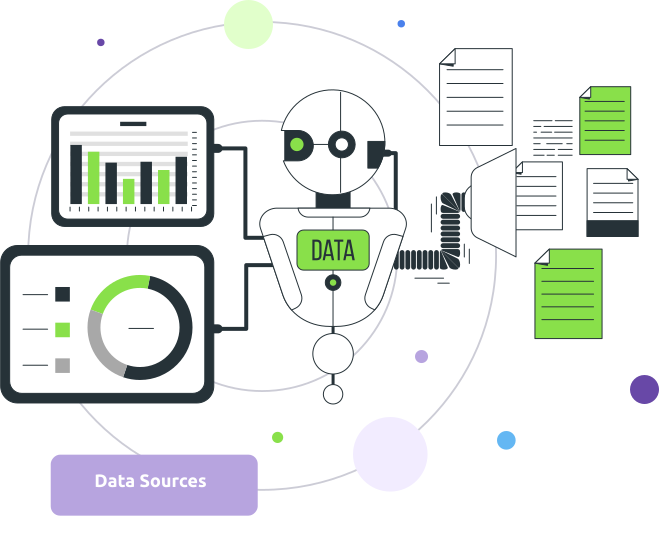
Our Porter's Five Forces analysis for Lumen Technologies is built upon a foundation of publicly available financial reports, industry-specific market research, and regulatory filings. We also incorporate insights from reputable business news outlets and analyst reports to provide a comprehensive view of the competitive landscape.